Brochure
Deliverz.ai Hospital Logistics Brochure
Discover AI-driven hospital logistics automation connecting people, workflows and autonomous robots, with platform capabilities, operational benefits and a Sheba Medical Center case study.
Short, clear answers about healthcare logistics automation, AI orchestration, robots, integrations, safety and deployment.
Healthcare logistics automation uses software, AI, autonomous robots, and other resources to automate and coordinate the movement of medications, specimens, supplies, equipment, and other items across healthcare facilities. deliverz.ai extends this beyond individual automated tasks by providing a unified orchestration layer that coordinates robots, people, workflows, and hospital infrastructure.
Hospitals can automate tasks such as robotic delivery of medications, laboratory specimens, blood products, supplies, equipment, linen, and meals, as well as the dispatch and coordination of human transporters. Hospital delivery robots can perform many routine point-to-point and multi-stop deliveries, while AI orchestration can assign, prioritize, route, and coordinate tasks across both robots and people.
Healthcare logistics automation can reduce delivery and wait times, increase throughput, improve resource utilization and operational predictability, reduce operational costs, free clinical staff from logistics tasks, and improve patient and staff satisfaction.
The ROI of hospital logistics automation comes from reducing manual transport effort (both transporters and dispatchers, and even clinical staff), increasing resource utilization and throughput, shortening delivery and wait times, reducing Length of Stay (LoS) and enabling hospitals to handle more demand without proportionally increasing staffing. ROI should therefore be evaluated not only through labor savings, but also through operational and clinical measures such as delivery performance, staff time saved, patient wait times, resource utilization, increased throughput and workflow efficiency.
Hospitals can reduce internal transport and delivery times by using hospital delivery robots for suitable workflows and intelligently assigning remaining tasks to the most appropriate available resource. Real-time orchestration can prioritize urgent deliveries and coordinate movement through elevators, doors, gates, multiple floors, and buildings.
Logistics automation can improve patient flow by reducing operational delays that prevent patients, medications, specimens, equipment, or transport resources from being where they are needed on time. Faster and more predictable logistics can help patients begin treatment sooner and reduce delays across interconnected hospital workflows.
Logistics automation can reduce clinical workload by shifting routine transport tasks from nurses and other caregivers to hospital delivery robots and dedicated transport resources. Robots can autonomously transport medications, specimens, supplies, and equipment, allowing clinical staff to spend more time on patient care, and also enabling transporters to focus on tasks such as patient transfer.
Yes, autonomous logistics systems can support continuous 24/7 hospital operations when robots, infrastructure, charging, workflows, and operational support are configured accordingly. Automated orchestration can continuously assign and prioritize missions across available resources, helping hospitals support logistics demand beyond individual staff shifts.
Traditional hospital transport services rely primarily on people and manual dispatching, while hospital logistics automation uses software, AI, and autonomous resources to automate and coordinate transport workflows. A unified orchestration approach can manage both robots and human transporters, dynamically assigning work based on location, availability, workload, priority, capability, and service-level requirements.
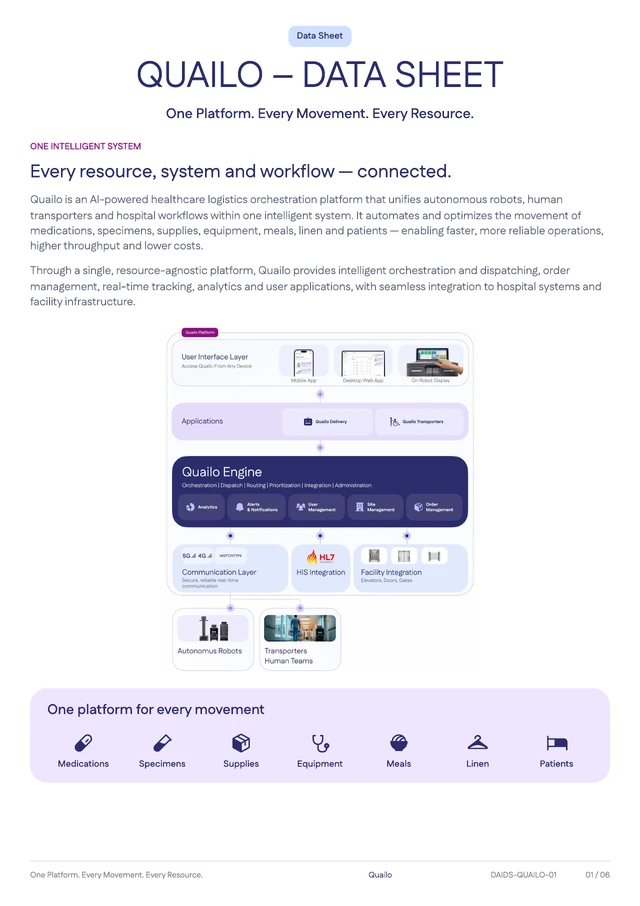
AI orchestration in healthcare logistics uses real-time data and intelligent decision-making to coordinate delivery tasks, resources, priorities, routes, and workflows across hospital operations. deliverz.ai provides a unified orchestration layer that coordinates autonomous robots and human transporters, dynamically managing resource allocation, prioritization, sequencing, and routing across the hospital.
AI-assisted dispatching continuously evaluates transport requests and available resources to recommend or automatically assign the most appropriate resource to each task. In hospitals, it can consider factors such as location, ETA, availability, current and queued workload, task priority, required capabilities, department eligibility, and remaining SLA time, while allowing dispatchers to intervene when needed.
Intelligent task assignment evaluates each delivery request against available resources and operational conditions to determine the most appropriate assignment. Rather than simply selecting the closest available resource, deliverz.ai can consider location, availability, workload, priority, ETA, capabilities, and SLA requirements when assigning hospital delivery robots or human transporters.
An intelligent logistics system can prioritize urgent hospital deliveries based on predefined priority levels, workflow rules, and service-level requirements. AI-assisted orchestration continuously evaluates the delivery queue and remaining SLA time so urgent tasks can be promoted and resources reassigned as operational conditions change.
Yes, AI orchestration can coordinate autonomous robots and human transporters as a single hybrid logistics workforce. deliverz.ai manages both within one platform, enabling hospitals to automate suitable delivery tasks with robots while intelligently assigning other tasks to human transporters.
Fleet management primarily focuses on monitoring and managing a fleet of robots or vehicles, while logistics orchestration coordinates the broader operation - including tasks, priorities, workflows, resources, routes, and service levels. In a hospital, orchestration can extend beyond robot fleet management to coordinate multiple robot vendors, human transporters, hospital workflows, and infrastructure through one unified platform. Such orchestration from a single platform eliminates the need for separate fleet management systems and multiple integrations with hospital information systems and facility infrastructure, while avoiding vendor lock-in and enabling diverse logistics use cases to be managed through a single platform.
Manual dispatching relies primarily on dispatchers to evaluate requests, select resources, and continuously reprioritize work, while AI-assisted dispatching uses real-time operational data to automate or recommend those decisions. In hospital transport operations, AI-assisted dispatch can continuously evaluate the entire resource pool, balance workloads, monitor SLAs, and prioritize urgent missions while keeping dispatchers in control of exceptions and overrides.
Yes, AI orchestration can coordinate logistics across multiple hospital departments, workflows, and resource types through a unified system. A platform such as deliverz.ai can manage workflows ranging from medications and specimens to supplies and patient transport while coordinating robots and human transporters across multi-floor and multi-building healthcare environments.
Robots are used in healthcare for applications including surgery, rehabilitation, cleaning, telepresence, and hospital logistics. In logistics, hospital robots can autonomously transport medications, specimens, blood products, supplies, meals, linen, and equipment, reducing manual transport, speeding up delivery times, increasing visibility, enabling predictability, and allowing clinical staff to focus more time on patient care.
Robots in hospitals are used to automate repetitive tasks such as delivering medications, specimens, supplies, meals, and equipment, as well as supporting cleaning, security, and other services. Hospital delivery robots can operate as part of a broader logistics system that coordinates their missions, routes, priorities, and interactions with hospital infrastructure.
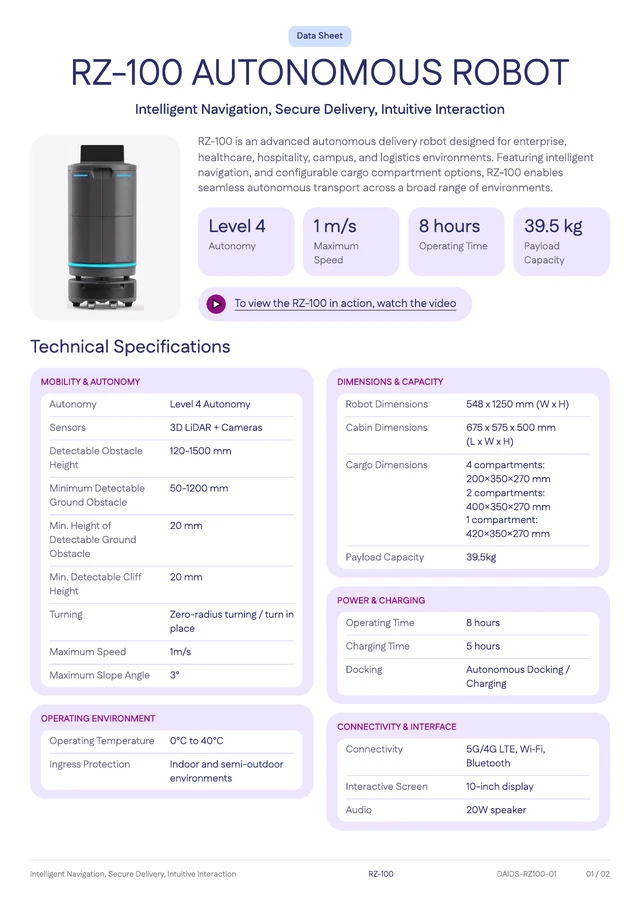
A hospital delivery robot is an autonomous mobile robot designed to transport items such as medications, specimens, blood products, supplies, meals, or equipment within a healthcare facility. These robots can navigate hospital environments autonomously and, when integrated with infrastructure, travel between floors and buildings using elevators, doors, and gates.
Hospital service robots are robots designed to perform non-surgical support tasks such as delivery, cleaning, guidance, security, or other operational services within healthcare facilities. Hospital delivery robots are one type of service robot, specifically designed to automate the movement of medications, specimens, supplies, meals, equipment, and other items.
An autonomous mobile robot (AMR) is a robot that can navigate and move through its environment without following a fixed physical path or requiring continuous human control. In hospitals, AMRs can be used as delivery robots to autonomously transport medications, specimens, supplies, meals, equipment, and other items between departments, buildings and floors.
Autonomous delivery robots in hospitals navigate independently between pickup and drop-off locations while detecting people and obstacles and interacting with hospital infrastructure when integrated. An orchestration platform such as deliverz.ai can assign and prioritize missions, optimize routes, and coordinate robots through elevators, doors, gates, multiple floors, and even separate buildings.
A service robot is a broad term for robots designed to perform tasks that assist people or organizations, while an autonomous mobile robot (AMR) specifically refers to a mobile robot that can navigate and operate autonomously within its environment. A delivery robot describes the robot’s application - transporting items such as medications, specimens, supplies, meals, or equipment. In hospital logistics, a robot can therefore be all three: a service robot, an AMR, and a delivery robot. The terms are often used interchangeably in the market, but they describe different aspects of the robot - its category, autonomy, and use case.
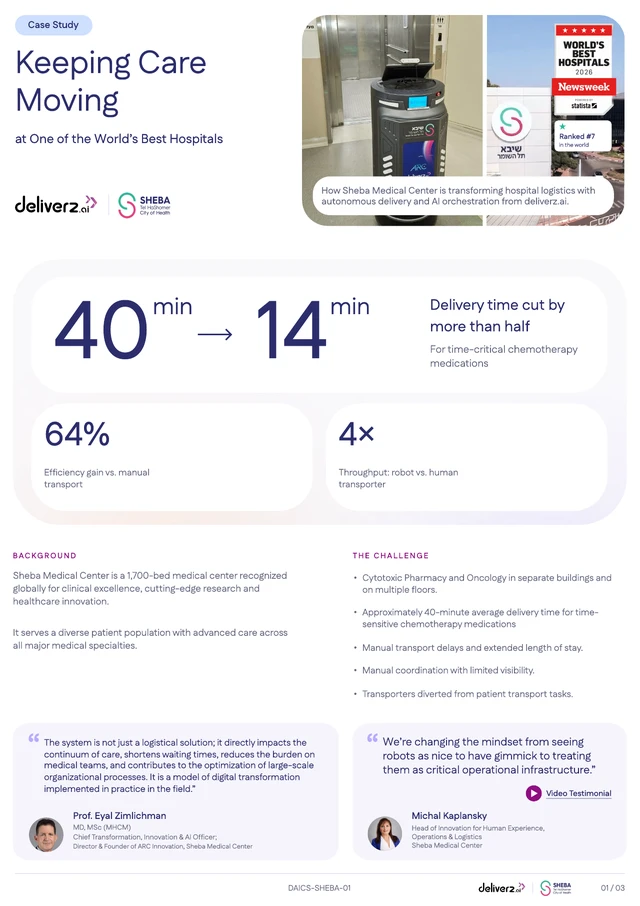
Autonomous robots can deliver medications, chemotherapy treatments, laboratory specimens, biopsies, blood products, medical supplies, meals, linen, equipment, waste, and other items across hospital facilities. At Sheba Medical Center, deliverz.ai-coordinated robots transport chemotherapy medications between the pharmacy and oncology units, with the deployment expanding to additional use cases including specimens and biopsies.
Yes, hospitals can use robots from multiple vendors when their logistics platform supports a robot-agnostic architecture. deliverz.ai provides a single integration and orchestration layer designed to support different robot types and vendors, allowing hospitals to select the appropriate robot for each use case without being locked into one manufacturer and without needing to use a different Fleet Management system for each robot type.
Robot-agnostic means a software platform is designed to work with robots from different manufacturers rather than being tied to one robot brand or fleet. In hospital logistics, this allows different types of hospital delivery robots to be managed through a common orchestration and integration layer and enables hospitals to add or change robot technologies as their needs evolve.
Not necessarily; an end-to-end logistics orchestration platform can incorporate robot management within the broader hospital logistics operation without the specific fleet management systems needed to be deployed. deliverz.ai coordinates robots, human transporters, tasks, routes, priorities, workflows, infrastructure, and analytics through one platform rather than treating the robot fleet as an isolated operation.
Yes, appropriately designed autonomous delivery robots can operate across both indoor and outdoor hospital environments. deliverz.ai supports robot types suited to different environments and orchestrates routes across indoor and outdoor areas, enabling deliveries across large, multi-building healthcare campuses.
Yes, hospital delivery robots can use elevators automatically when the robot and elevator systems are appropriately integrated. This enables autonomous deliveries across multiple floors, with the robot able to call the elevator, select the required floor, and continue its mission without requiring a staff member to accompany it.
Yes, autonomous robots can automatically pass through compatible doors and gates when integrated with the hospital’s facility or access-control systems. deliverz.ai provides infrastructure integration for elevators, automatic doors, gates, and access control so delivery robots can complete end-to-end missions with minimal human intervention.
Yes, hospital delivery robots can support 24/7 operations when charging, workflows, infrastructure integrations, and operational support are configured accordingly. deliverz.ai is designed to orchestrate continuous hospital logistics operations across autonomous robots and human transport resources, helping hospitals support round-the-clock delivery demand.
Autonomous robots typically return to designated charging stations when their batteries reach a configured level, with many systems supporting automatic docking and charging. Charging can be incorporated into fleet and mission planning, and robots can also be configured to automatically return to a charging station whenever they are not on a mission, maximizing available charging time even when the battery is not low. This helps keep robots charged and available for hospital deliveries while minimizing disruption to operations.
An autonomous robot can detect an unexpected obstacle, slow or stop, and attempt to safely navigate around it based on its navigation capabilities and operating rules. If the route remains blocked or the mission cannot continue safely, the system can trigger an exception so the situation can be resolved or the delivery reassigned or rerouted.
Robot-as-a-Service (RaaS) is a commercial model in which organizations access robots and associated services through a recurring subscription or service fee rather than purchasing the robots outright. deliverz.ai combines RaaS with SaaS-based logistics orchestration, with support and maintenance included, enabling hospitals to deploy and scale autonomous delivery while reducing large upfront capital requirements. At the end of a lease term, hospitals can transition to newer or more advanced robot technologies if desired, providing greater flexibility, ongoing support, and investment protection as robotics technology continues to evolve.
Autonomous robots are primarily used to automate repetitive transport tasks rather than replace the broader roles performed by hospital staff. deliverz.ai uses a hybrid workforce approach, coordinating robots and human transporters so suitable deliveries can be automated while people remain available for tasks requiring human capabilities, judgment, or patient interaction.
AI can coordinate robots and human transporters by assigning each delivery to the most appropriate available resource based on factors such as location, priority, workload, capabilities, and delivery requirements. deliverz.ai uses intelligent orchestration to manage hospital robots and human transporters as a single hybrid workforce through one healthcare automation platform.
A hospital can assign a robot or human transporter based on factors such as task type, urgency, location, resource availability, workload, and operational rules. With deliverz.ai, these factors can be evaluated automatically so each hospital delivery is assigned to the most appropriate resource.
Yes, a single platform can manage both autonomous robots and human transporters as part of one hospital logistics operation. deliverz.ai provides healthcare automation software that orchestrates both resources, giving hospitals unified dispatch, tracking, workflow management, and analytics.
Hybrid workforce orchestration is the coordinated management of people and autonomous systems through a single intelligent platform. In hospital logistics, deliverz.ai applies this approach to orchestrate human transporters and autonomous robots for tasks such as medication delivery, specimen transport, and movement of supplies.
Automated transporter dispatch uses software and AI to match hospital transport requests with the most appropriate available transporter. deliverz.ai can evaluate location, availability, workload, priority, capabilities, ETA, and SLA requirements to recommend or automatically make assignments.
AI improves hospital transporter utilization by continuously matching demand with available resources and reducing inefficient assignments, idle time, and unnecessary travel. deliverz.ai uses AI-assisted dispatch to help hospitals make better use of their transporter workforce while maintaining service levels and delivery priorities.
AI can balance transporter workloads by considering each transporter’s location, availability, active assignments, queued workload, capabilities, and expected travel time before assigning new tasks. This enables more intelligent automation for healthcare logistics and helps prevent individual transporters from becoming overloaded while others remain underutilized.
Yes, dispatchers can retain control and override AI-generated assignments when operational circumstances require it. deliverz.ai combines AI-assisted dispatch with human oversight, allowing dispatchers to approve recommendations, manually assign or reassign tasks, and respond to exceptions.
Urgent transport requests can be automatically prioritized based on predefined rules, clinical urgency, delivery type, SLA requirements, and remaining delivery time. An intelligent orchestration platform such as deliverz.ai can continuously adjust assignments and resource priorities as conditions change.
Autonomous robots do not necessarily replace hospital transporters; they can take over repetitive, predictable delivery tasks while human transporters focus on work that requires greater flexibility or human interaction, such as patient transfer. deliverz.ai orchestrates autonomous robots and people together, enabling hospitals to use each resource where it is most effective.
Yes, autonomous robots can integrate with hospital elevators to call elevators, select floors, enter, ride, and exit without human assistance. deliverz.ai supports elevator integration as part of its healthcare automation platform, enabling autonomous delivery robots to operate across multiple hospital floors.
Autonomous robots can integrate with automatic doors so they open automatically when an authorized robot approaches. This allows hospital robots to move securely and independently through facilities without requiring staff to open doors manually.
Yes, autonomous robots can integrate with gates and access control systems to move through authorized areas while maintaining hospital security requirements. deliverz.ai supports these infrastructure integrations as part of end-to-end hospital robotic delivery workflows.
Not necessarily; many existing elevators, automatic doors, and access control systems can be integrated with autonomous robots using their existing interfaces or appropriate integration hardware. Requirements depend on the hospital’s infrastructure, elevator type and model, and deliverz.ai works with existing facility systems to minimize changes wherever possible.
Yes, a robot-agnostic integration layer can support autonomous robots from multiple vendors without requiring hospitals to build a separate operational platform for each one. deliverz.ai provides a unified integration and orchestration layer that enables hospitals to manage different robot types and vendors through one healthcare automation platform.
Yes, autonomous robots can operate across multiple floors and, depending on the robot and environment, between multiple buildings. By integrating navigation with elevators, doors, gates, and other infrastructure, deliverz.ai can orchestrate hospital robot delivery across complex indoor and outdoor environments.
Hospital maps and delivery routes are configured during deployment by mapping operational areas, destinations, restricted zones, elevators, doors, and other relevant infrastructure. Autonomous robots use these maps for navigation, while deliverz.ai orchestrates delivery workflows, destinations, and resources across the hospital.
Yes, healthcare logistics platforms can integrate with hospital information systems to automatically initiate, update, and track logistics workflows based on hospital data and events. deliverz.ai provides a unified integration layer connecting logistics automation with hospital systems and operational workflows.
Autonomous logistics systems can integrate with an EMR to trigger and update delivery workflows based on relevant clinical and operational events. This can enable workflows such as medication delivery or specimen transport to connect directly with hospital processes rather than operating as standalone robot tasks.
Yes, autonomous logistics systems can integrate with Admission, Discharge, and Transfer (ADT) systems to use relevant patient location and workflow events within hospital logistics processes. This can help healthcare automation software dynamically route or trigger deliveries based on changes in patient location or status.
Yes, healthcare logistics platforms can integrate with Computerized Maintenance Management Systems (CMMS) when logistics workflows need to connect with equipment, assets, maintenance requests, or facility operations. This enables autonomous delivery and other hospital logistics activities to become part of broader operational workflows.
Yes, healthcare logistics systems can support healthcare interoperability standards such as HL7 and FHIR to exchange information with hospital systems. deliverz.ai can use standards-based integrations to connect healthcare logistics automation with systems such as EMRs and other hospital applications.
Autonomous robots can transport medications, chemotherapy drugs, blood products, laboratory specimens, medical supplies, equipment, linen, meals, and other materials throughout hospitals. These healthcare robots can automate repetitive hospital delivery workflows while providing predictable transport, real-time visibility, and traceability.
Yes, autonomous robots can securely transport chemotherapy medications from the pharmacy to oncology and infusion areas. Secure compartments and chain-of-custody tracking can help protect hazardous medications while reducing transport delays, manual coordination, and staff time spent on medication delivery.
Medication delivery robots autonomously transport medications from hospital pharmacies to nursing units, oncology, the ED, OR, outpatient areas, and other authorized destinations. Integrated with healthcare automation software, an autonomous delivery robot can receive delivery missions, navigate the hospital, use elevators and doors, securely carry medications, and provide real-time delivery tracking.
Yes, autonomous robots can transport blood products from the blood bank to locations such as the OR, ED, oncology, inpatient units, and other clinical areas. Hospital robotic delivery can provide faster, more predictable transport while supporting secure chain of custody and end-to-end traceability.
Yes, autonomous robots can transport laboratory samples and specimens from care areas to laboratories and pathology departments. Automated specimen transport can reduce manual pickups, improve delivery predictability and traceability, and help shorten laboratory turnaround times.
Yes, hospital robots can transport medical supplies and consumables to nursing units, procedural areas, and other points of care. Automating supply delivery and replenishment can reduce staff time spent searching for or transporting supplies while helping keep care areas reliably stocked.
Yes, autonomous delivery robots can transport patient meals and other food-service items throughout a hospital. Automated meal delivery can provide more consistent, on-time distribution while reducing the manual transport workload on nutrition services teams.
Yes, autonomous robots can support both clean-linen distribution and linen collection workflows within hospitals. Automating repetitive linen routes can improve replenishment consistency, reduce manual transport requirements, and support faster room readiness.
Yes, autonomous robots can transport appropriate medical equipment between storage areas, clinical units, and procedural locations. Automated equipment distribution can improve equipment availability, reduce staff time spent locating and moving devices, and support faster procedure readiness.
Yes, autonomous robots can perform pharmacy-to-unit medication deliveries across inpatient and outpatient areas. deliverz.ai can orchestrate deliveries from central, IV, and oncology pharmacies to destinations such as nursing units, the OR, ED, oncology, and other care areas while providing real-time tracking and chain of custody.
Yes, autonomous robots can support oncology workflows by transporting chemotherapy medications, specimens, blood products, supplies, and other materials between pharmacy, laboratories, blood banks, and oncology areas. Automating these time-sensitive movements can reduce treatment delays and staff logistics workload while helping improve infusion center throughput.
Yes, autonomous robots can perform both scheduled and recurring hospital deliveries in addition to on-demand missions. Healthcare automation software can automatically coordinate routine workflows such as medication delivery, supply replenishment, specimen transport, meals, and linen routes.
Yes, autonomous robots can support STAT and urgent hospital deliveries when the workflow, payload, and robot are appropriate for the task. An orchestration platform such as deliverz.ai can prioritize urgent requests and dynamically dispatch available resources based on priority, location, delivery requirements, and operational rules.
Yes, autonomous robots can support multi-stop missions with multiple drop-offs or pickups during a single route when the robot configuration and workflow allow it. Multi-drop-off hospital robot delivery can increase delivery efficiency by moving multiple items or serving multiple destinations during one mission.
Chain of custody can be maintained through secure compartments, controlled access, user authentication, timestamps, lock and unlock events, and a digital record map view of the delivery from pickup through drop-off. deliverz.ai provides end-to-end traceability for sensitive workflows such as medication delivery, chemotherapy drugs, specimens, and blood transport.
Yes, depending on its payload configuration and technical capabilities, the same autonomous robot can support multiple hospital delivery use cases. With deliverz.ai’s robot-agnostic orchestration, hospitals can use appropriate robots across workflows such as medications, specimens, supplies, equipment, meals, and linen rather than deploying a separate automation platform for every use case.
Yes, autonomous delivery robots are designed to operate safely in dynamic hospital environments alongside patients, visitors, and staff. Hospital robots use sensors, navigation software, speed controls, and obstacle detection to continuously monitor their surroundings and adjust their movement.
Cargo can be transported in enclosed, secured compartments that remain locked during autonomous delivery. For sensitive items such as medications, chemotherapy drugs, blood products, and specimens, controlled access helps protect the contents from pickup through authorized drop-off.
Chain of custody is maintained through a digital record of the delivery, including pickup, transport, access, and drop-off events. deliverz.ai can record timestamps, compartment lock and unlock activity, authorized user access, delivery status, and route history to provide end-to-end traceability.
Access to robot compartments can be restricted to authorized users through methods such as employee badges, credentials, PINs, or other authentication mechanisms supported by the deployment. Access events can be recorded so hospitals know who opened a compartment, where and when.
Medication delivery and specimen transport can be tracked from pickup through drop-off using real-time mission status, timestamps, location information, and compartment access records. deliverz.ai maintains a digital delivery history that supports traceability and auditing of sensitive hospital logistics workflows.
An autonomous robot can detect an obstacle and respond by slowing down, stopping, or calculating an alternative route when possible. If the obstacle cannot be safely bypassed, the robot can wait or generate an exception or find an alternative route so the delivery can be addressed without compromising safe navigation.
If a robot cannot complete a delivery, the logistics platform can identify the exception and alert the appropriate operational team. With deliverz.ai, the workflow can be reassigned, escalated, or handled by another robot or human transporter so the underlying hospital delivery can still be completed.
Autonomous logistics systems should use multiple layers of security, including encrypted communications, authentication, role-based access, secure cloud infrastructure, device security, logging, and monitoring. Security covers both the healthcare automation software and the connections between robots, hospital systems, and infrastructure.
They do not necessarily need to handle Protected Health Information (PHI) to coordinate hospital logistics. deliverz.ai is designed to orchestrate deliveries using operational information without requiring PHI, reducing the amount of sensitive clinical data involved in the logistics workflow.
Healthcare logistics platforms can be designed to support a hospital's HIPAA requirements, but compliance depends on the architecture, data handled, integrations, and deployment. deliverz.ai is designed to be HIPAA-aligned and does not require PHI for its core healthcare logistics automation workflows.
User access can be controlled through authenticated accounts and role-based permissions that determine which functions and information each user can access. This allows hospitals to restrict administrative, operational, and reporting capabilities according to each user's responsibilities.
Yes, delivery activity and compartment access can be recorded to provide an auditable history of hospital logistics operations. deliverz.ai can capture mission events, timestamps, user access, lock and unlock activity, route information, and delivery completion data for chain-of-custody reporting and operational review.
Implementation timelines vary depending on the number of workflows, robots, integrations, and hospital infrastructure involved. A focused pilot in one department can typically be deployed much faster than an enterprise-wide program, allowing hospitals to validate workflows and outcomes before expanding.
Yes, hospitals can begin logistics automation within a single department or workflow and expand over time. Starting with a clearly defined use case such as pharmacy-to-oncology medication delivery or specimen transport makes it easier to measure operational and clinical impact.
An autonomous robot pilot typically includes workflow assessment, facility mapping, infrastructure integration, robot configuration, staff training, operational testing, and KPI measurement. The goal is to validate both the technology and its impact on hospital operations before scaling.
The best starting department is usually one with high delivery volume, repetitive workflows, measurable delays, and significant staff time spent on transport. Pharmacy, oncology, laboratories, and supply distribution are often strong starting points because workflows such as medication delivery and specimen transport can produce clearly measurable results.
Not necessarily; many existing hospital elevators, doors, networks, and access control systems can be integrated with autonomous robots using existing interfaces or appropriate integration hardware. Infrastructure requirements are assessed during deployment so changes can be minimized wherever possible.
Hospital workflows are configured by defining pickup and drop-off locations, delivery priorities, schedules, authorized users, resource requirements, SLAs, and exception rules. deliverz.ai then uses these operational rules to orchestrate autonomous robots and human transporters through a unified healthcare automation platform.
Autonomous robots are typically introduced through mapping, testing, staff training, controlled workflow validation, and gradual transition into live operations. This phased approach allows navigation, infrastructure integrations, and delivery processes to be validated without disrupting patient care.
The number of robots depends on delivery volume, operating hours, travel distances, mission duration, peak demand, charging requirements, and the number of workflows being automated. Fleet sizing should be based on actual hospital logistics demand rather than simply the size of the facility.
Yes, hospitals can add additional robots as delivery volume, departments, or automation use cases increase. A scalable healthcare automation platform such as deliverz.ai allows hospitals to expand fleet capacity without redesigning the overall logistics operation.
Yes, hospitals can begin with one workflow or department and progressively expand automation across pharmacy, laboratories, blood bank, supplies, equipment, nutrition, linen, and other services. A unified orchestration platform makes it easier to manage additional workflows as part of the same hospital-wide logistics operation.
Yes, a robot-agnostic platform can allow hospitals to add different robot types and vendors as requirements evolve. deliverz.ai provides a unified orchestration and integration layer that helps reduce vendor lock-in while enabling hospitals to select the most appropriate robot for each use case.
Autonomous robot fleets are monitored through fleet and logistics management software that provides real-time visibility into missions, robot status, location, availability, charging, exceptions, and delivery performance. deliverz.ai adds orchestration across robots and human transporters so hospitals can manage the complete logistics operation rather than individual robot fleets in isolation.
Autonomous robots can automatically return to designated charging stations and dock without staff assistance. Charging can be incorporated into mission planning, and robots can also be configured to return to a charger whenever they are idle to maximize available charging time even when the battery is not low.
Autonomous delivery systems typically include ongoing software support, monitoring, maintenance, updates, and robot servicing as part of the operating model. With a Robot-as-a-Service approach, support and maintenance can be included in the recurring service rather than managed separately by the hospital.
Robot-as-a-Service (RaaS) allows hospitals to deploy autonomous robots through a recurring service fee instead of purchasing the equipment outright. deliverz.ai combines RaaS with healthcare automation software, including support and maintenance, while also giving hospitals flexibility to upgrade to newer robot technology at the end of a lease term, helping protect their investment.
Hospital logistics automation is measured by comparing operational performance before and after deployment across delivery speed, throughput, staff utilization, service levels, and workflow reliability. Analytics can also show how automation affects waiting time, clinical interruptions, resource utilization, and delivery predictability.
Hospitals should track KPIs such as total deliveries, average pickup-to-drop-off time, SLA performance, wait-time savings, deliveries per resource, resource utilization, throughput, exceptions, and on-time delivery rates. Depending on the workflow, hospitals can also measure nursing or pharmacy time saved, procedure delays, turnaround times, and operational efficiency gains.
Data sheets, brochures, white papers and case studies, all in one place.